
Flying F3A
Welcome to the world of F3A R/C aerobatics, where precision, skill and aeronautical artistry converge to take your R/C flying experience to a new level.
Whether you’re a seasoned pilot or a newcomer to the hobby, F3A aerobatics can significantly enhance your enjoyment and mastery of your existing aircraft.
F3A, also known as Pattern Flying, is a discipline that challenges pilots to execute a predetermined sequence of aerobatic manoeuvers with precision and finesse. The structured schedules provide a progression path taking your flying to the next level.
F3A can be flown with any aircraft that can loop, roll and fly inverted, with a wingspan / fuselage length of up to 2m and a maximum weight of 5.5Kg.
Whether you aspire to compete in aerobatic events or simply want to enhance your flying skills, F3A R/C aerobatics holds the key. So, if you’re ready to take your aircraft to new heights and experience the thrill of precision flying, join UKF3A and let the sky become your canvas.
Getting Started
Newcomers Entry Level Schedule
We’d love to have you join us at a competition! No need to be judged, just come along, meet some friendly faces and get guidance from a mentor to help you feel more confident with your aircraft. It’s all about learning, support and enjoying the journey.
View the Entry Level ScheduleManoeuvre Basics Quick Ref
The quick reference for basic manoeuvres emphasises distinctions in the aircraft’s attitude compared to its flight path. It includes explanations of wind correction, lines, loops, rolls, stall turns and spins.
View the Manoeuvre Basics Quick RefPost on our Forum
Ask any questions you may have in our forum’s General F3A Discussion. Whether it’s finding F3A pilots flying near you or advice on any aspect of aerobatics, our community is ready to provide assistance.
Go to our ForumBook
Model Aircraft Precision Aerobatics is a book for newcomers and pilots wanting to improve. Details can be found below.
Recordings of “In the Air Tonight”
The ‘In the Air Tonight’ webinar series, presented by the British Model Flying Association (BMFA), showcases two informative sessions by Kevin Caton. The first webinar, titled “Aerobatics for Everyone,” covers fundamental aspects, while the second, “Moving Forward with Aerobatics,” delves deeper into specific topics and introduces new ones.
View Aerobatics for Everyone View Moving Forward with AerobaticsUKF3A Open Days
UKF3A Open Days are for club flyers looking to boost their skills, with guidance from experienced F3A pilots, in a friendly and relaxed setting. They offer a step from club flying to the next level. Click on our Calendar / Results (Main Menu) to see when one is scheduled.
Trimming
In this video series, Juan Rombaut walks you through the steps of trimming an F3A aircraft. Part 1 offers a broad overview, Part 2 delves into more specific details and Part 3 focuses on rates and expo settings. Subsequent parts cover additional aspects of flying F3A.
View Juan Rombaut’s series on F3A BasicsThe Trimming Guide complements the preceding video series by providing concise and detailed information, for easy reference when out at your flying site.
UKF3A Trimming Guide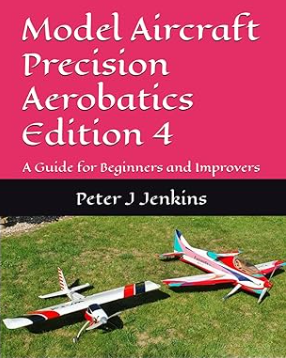
Model Aircraft Precision Aerobatics Edition 4
Edition 4 of this book describes how to fly the 2026 and onwards UKF3A Association Clubman and Intermediate Schedules. This Edition also includes a new section on RC Transmitters and the functions that are particularly useful for precision aerobatics as well as numerous other updates.
This book is a guide both for beginners as well as improvers to model aircraft precision aerobatics, or F3A, competition focused on UK schedules. However, it is just as relevant anywhere else in the world as the issue of how to control an aerobatic model aircraft is not limited to a single geography! If you are not interested in entering competitions, this book will bring you some of the knowledge and techniques that you would only pick up by attending them. If you are sufficiently disciplined in your flying, there is no reason why you should not reach a good aerobatic standard after following the advice and guidance contained in this book.
This is the book I would like to have had when I took up aerobatics and first entered competitions. If like me, you have wanted to take up precision aerobatics but couldn’t find any resources to help you, this is the book for you. The book covers the basics of starting aerobatic flying, from when you have just gone solo, to helping you to get ready to take up the challenge of flying in aerobatic competitions.
The book contains advice on how to set up your aircraft covering for example: centre of gravity position; engine/motor thrust lines; control throws and how to set up your Transmitter functions. It then takes you through the basics of aerobatic manoeuvres with both diagrams and words. Once over this initial phase, you will get much more detail about set up and trimming as well as how to fly large smooth manoeuvres ultimately taking account of the impact of the wind on the flight.
The book contains a chapter on mini training schedules that allow you to build up your skills before describing how to transition to the Intermediate Schedule. Finally, I have included references to how you can access the resources to help you to progress from a practical flying viewpoint.
Alternatively, you can buy the hardback and paperback at a discount by contacting Peter Jenkins by email or via a PM through the Forum.
Advanced Precision
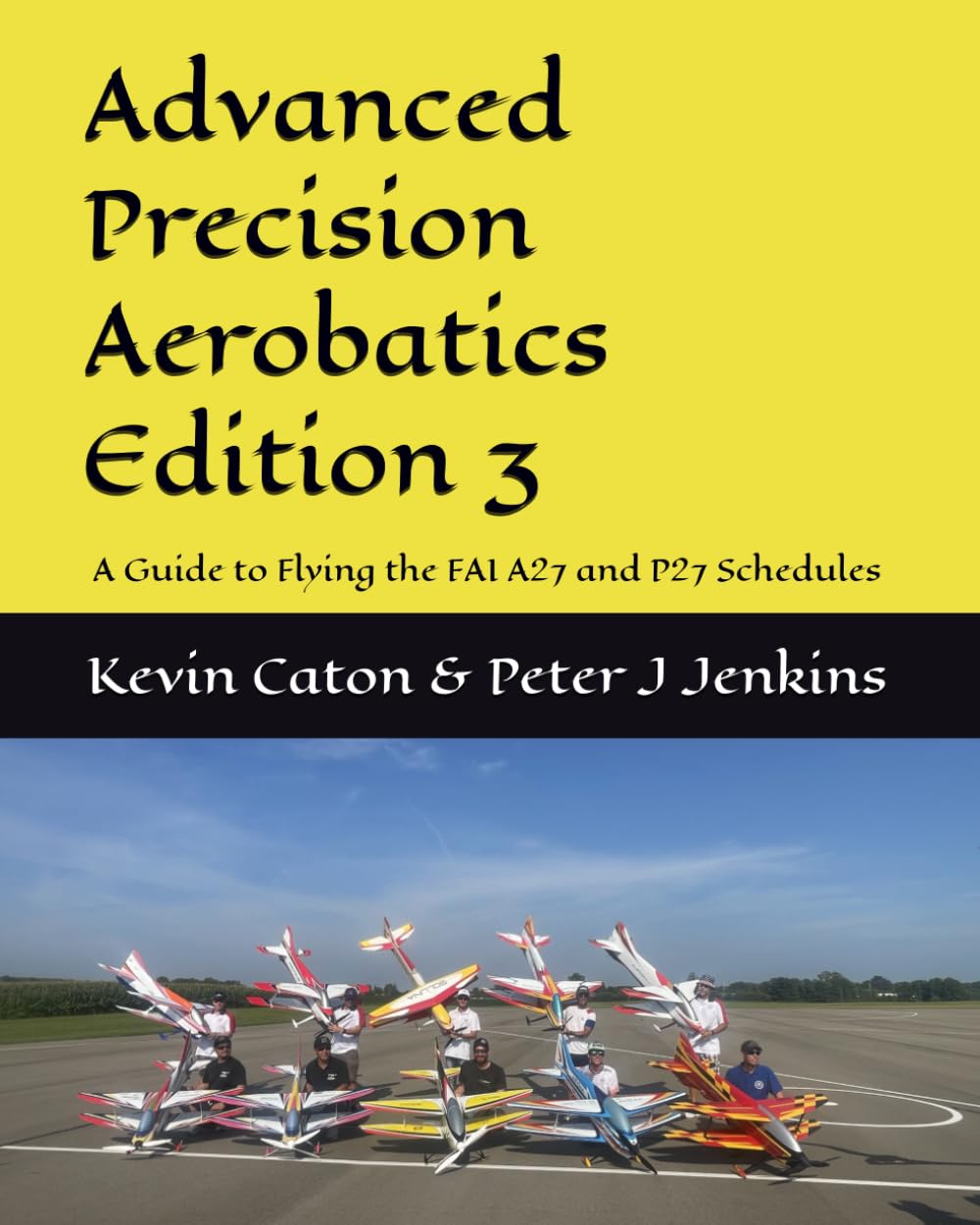
Aerobatics Edition 3 –
A Guide to Flying the FAI A27 and P27 Schedules
This book is for those who are new to or attempting to improve their performance of the FAI Model Aircraft Aerobatic Schedules A27 and P27.
The book covers the topics of trimming, transmitter setup, aircraft and control setup, how to practice effectively, countering wind effects and what is involved in competition flying.
We also refer to how best to use Flight Coach to improve your flying.
The FAI P27 or Preliminary Schedule is flown in all Continental and World Championships and is usually used in National Competitions.
The FAI A27 or Advanced Schedule, is the precursor to the P27 and has the same manoeuvre geometry but with fewer in-manoeuvre elements. The objective of flying A27 is that it enables an easier transition to P27 as the overall geometry remains the same. In the UK, both A27 and P27 are used in the National League competitions.
Alternatively, you can buy the hardback and paperback at a discount by contacting Peter Jenkins by email or via a PM through the Forum.